The Invisible Crisis Within Hospital Walls
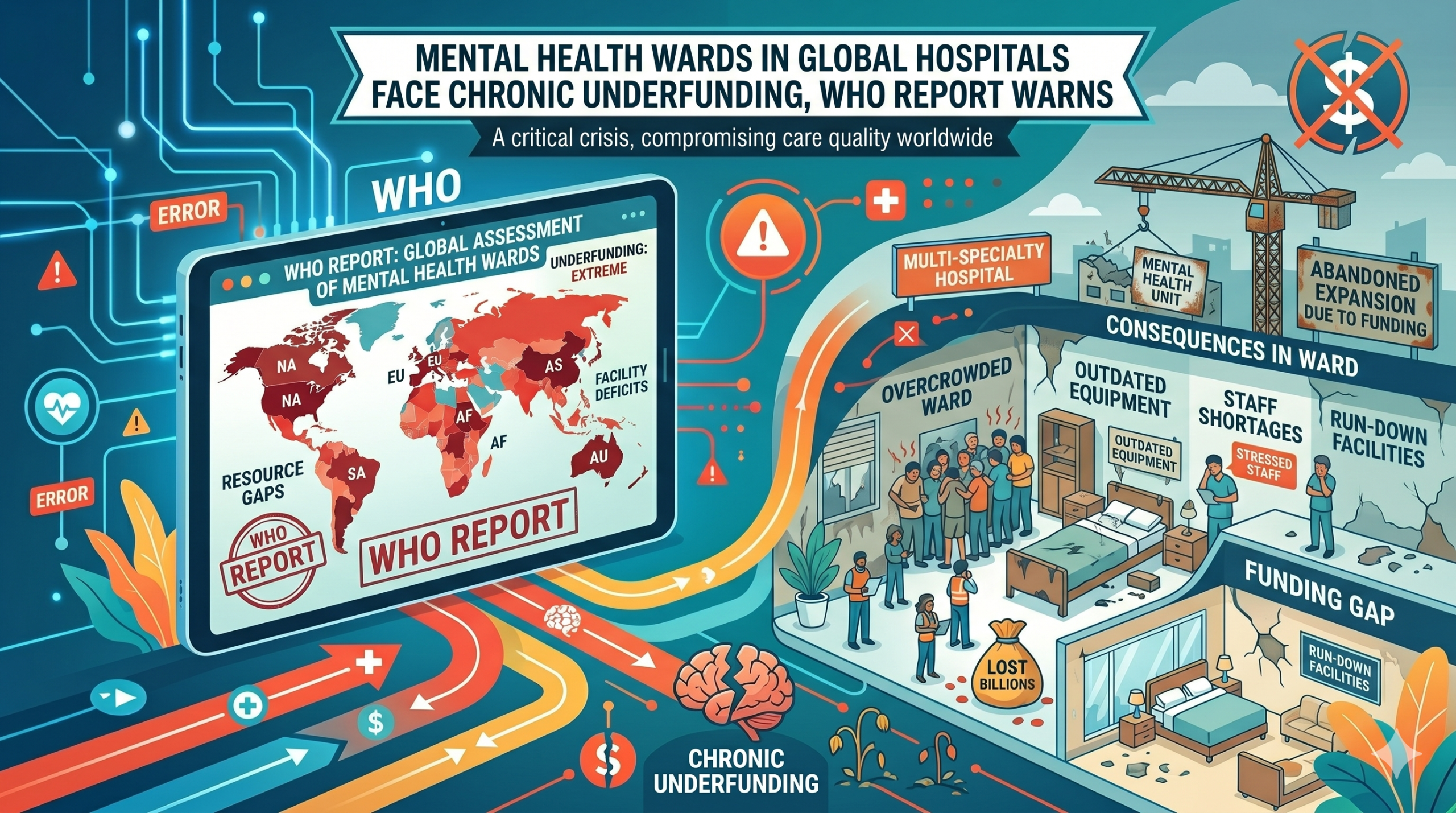
Behind the bustling corridors of hospitals worldwide, a quieter crisis festers in wards that rarely make headlines. Mental health departments — the units responsible for treating depression, psychosis, bipolar disorder, schizophrenia, acute anxiety, and suicidal ideation — are chronically starved of the funding, staffing, and institutional attention they need to function effectively. The World Health Organization has repeatedly sounded the alarm, warning that the gap between the burden of mental illness and the resources devoted to treating it represents one of the most glaring failures in modern healthcare. Yet year after year, the warnings go largely unheeded, and millions of patients pay the price.
Mental health conditions account for a staggering share of the global disease burden. Depression alone ranks among the leading causes of disability worldwide. Anxiety disorders, substance use disorders, and severe psychiatric illnesses collectively affect more than one billion people across every nation, culture, and income bracket. The economic toll — measured in lost productivity, healthcare expenditure, and social welfare costs — runs into trillions of dollars annually. By any rational measure, mental health should command a commensurate share of healthcare investment. Instead, it remains the most underfunded and overlooked domain in hospital systems around the world.
A Funding Gap That Defies Logic
The numbers are as stark as they are difficult to justify. Globally, governments allocate an average of just 2 percent of their healthcare budgets to mental health. In low-income countries, the figure drops below 1 percent. Even in wealthy nations that pride themselves on comprehensive healthcare systems, mental health funding consistently lags behind investment in cardiology, oncology, surgery, and other clinical specialties. The result is a chronic resource deficit that manifests in every dimension of mental healthcare delivery — from crumbling inpatient facilities and equipment shortages to dangerously low staffing ratios and limited access to evidence-based therapies.
Hospital mental health wards often occupy the oldest, most neglected sections of medical campuses. While surgical suites receive state-of-the-art upgrades and emergency departments benefit from regular investment, psychiatric units frequently operate in aging infrastructure that fails to meet modern standards of safety, dignity, and therapeutic design. Overcrowded rooms, inadequate privacy, poor ventilation, and institutional aesthetics that more closely resemble detention facilities than healing environments remain disturbingly common, even in high-income countries.
The physical environment matters profoundly in mental healthcare. Research demonstrates that ward design directly influences patient outcomes, with therapeutic environments — those incorporating natural light, calming colors, outdoor access, and private spaces — contributing to reduced agitation, shorter hospital stays, and lower rates of coercive intervention. When mental health wards are treated as architectural afterthoughts, the clinical consequences are measurable and the human consequences are deeply felt.
The Workforce Desert
Perhaps nowhere is underfunding more acutely felt than in the mental health workforce. The WHO estimates that there are fewer than 1 mental health worker per 10,000 people globally, with the distribution skewed dramatically toward wealthier nations. In low- and middle-income countries, entire populations of tens of millions may be served by a handful of psychiatrists. Sub-Saharan Africa averages fewer than 0.1 psychiatrists per 100,000 people — a ratio so thin it renders comprehensive psychiatric care functionally impossible.
Even in nations with relatively more resources, psychiatric nursing positions go unfilled, psychologist vacancies persist for months, and occupational therapists specializing in mental health are treated as expendable luxuries rather than essential team members. The professionals who do work in mental health wards often face working conditions that drive high turnover: heavy caseloads, exposure to patient aggression, emotional exhaustion, limited career progression, and salaries that trail behind colleagues in other medical specialties.
The workforce crisis creates a devastating cascade. When psychiatric wards are understaffed, patients receive less individual attention, therapeutic programs are curtailed, and the risk of adverse events — self-harm, patient-on-patient violence, inappropriate use of restraint and seclusion — increases. Staff who remain absorb the growing burden, their own mental health deteriorating under the weight of impossible demands. The cycle feeds itself relentlessly.
Patients Caught in the Gap
For the individuals who depend on hospital mental health services, chronic underfunding translates into suffering that is both avoidable and unjust. Patients experiencing acute psychiatric crises frequently wait hours or days in general emergency departments — environments entirely unsuited to their needs — because psychiatric beds are unavailable. Those who are admitted may receive stabilization through medication but are discharged before they have access to the psychotherapy, social support planning, and community integration services that determine long-term recovery.
Readmission rates for psychiatric patients remain alarmingly high across virtually every healthcare system studied. The revolving door of admission, brief stabilization, premature discharge, and inevitable relapse reflects not a failure of individual patients but a systemic failure to invest in the continuum of care that mental health recovery demands. Community mental health services — the outpatient clinics, crisis teams, supported housing programs, and vocational rehabilitation services that should catch patients before they reach crisis point — are themselves underfunded, creating gaps through which vulnerable people repeatedly fall.
The most marginalized populations bear the heaviest burden. People experiencing homelessness, incarceration, substance dependency, and social isolation are disproportionately affected by severe mental illness and disproportionately failed by underfunded services. In many countries, prisons and jails have effectively become the largest psychiatric institutions — a grim reality that represents both a moral indictment and a policy failure of the highest order.
Stigma as a Budget Line
Underlying the funding crisis is a factor that cannot be measured in currency but shapes every budget decision: stigma. Mental illness, despite decades of awareness campaigns, continues to carry social and institutional stigma that influences how governments, hospital administrators, and the broader public perceive its importance relative to physical health conditions.
A hospital board debating capital investment will more readily approve a new cardiac catheterization laboratory than a redesigned psychiatric ward. A finance ministry allocating health spending will prioritize visible, technology-driven specialties over the less photogenic work of psychiatric care. Politicians campaigning on healthcare platforms highlight cancer treatment and surgical waiting lists far more frequently than psychiatric bed shortages or community mental health funding.
This institutional bias is rarely explicit. It operates through omission rather than opposition — mental health is simply not prioritized when competing demands press against limited budgets. The result is a persistent pattern of neglect that perpetuates itself across electoral cycles, budget rounds, and strategic planning horizons.
The Path Toward Parity
Breaking the cycle requires a fundamental shift in how health systems value and finance mental healthcare. The WHO and leading mental health organizations advocate for parity — the principle that mental health services should receive funding, attention, and institutional support commensurate with their share of the disease burden. Achieving parity means increasing mental health budget allocations, investing in workforce development, modernizing inpatient facilities, and building robust community-based services that reduce reliance on hospital admission.
Several countries offer instructive models. Australia and New Zealand have implemented national mental health strategies that ring-fence dedicated funding streams. The United Kingdom’s drive toward parity of esteem between physical and mental health, while still incomplete, has elevated the issue to mainstream policy discourse. Low-resource innovations in countries like Zimbabwe and India — where community health workers are trained to deliver basic psychological interventions — demonstrate that progress is possible even without wealthy-nation budgets.
A Test of Civilization
How a society treats its most vulnerable members remains the truest measure of its character. People living with mental illness — frightened, stigmatized, and frequently voiceless — deserve healthcare systems that meet them with competence, compassion, and adequate resources. The chronic underfunding of hospital mental health wards is not an inevitable reality. It is a choice, repeated annually in budget spreadsheets and boardroom priorities around the world. The WHO’s warnings are clear. The evidence is overwhelming. What remains is the will to act.




Be First to Comment