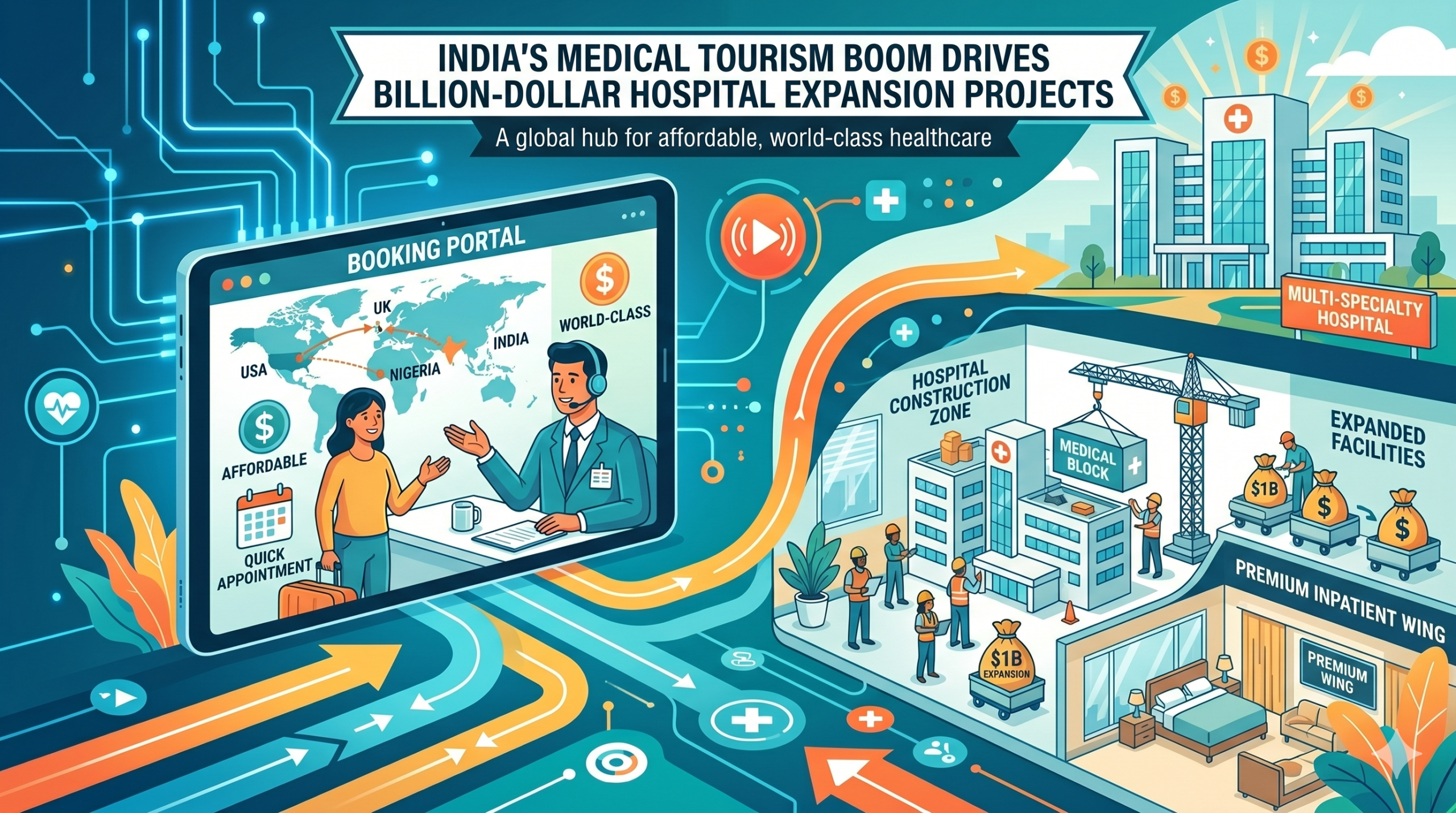
The World Comes to India for Care
India has long been known as a land of ancient healing traditions, but today it is the country’s gleaming modern hospitals that are drawing global attention. A medical tourism boom of extraordinary proportions is transforming India’s healthcare landscape, attracting millions of international patients each year and fueling a wave of billion-dollar hospital expansion projects that are reshaping skylines from Delhi to Chennai, Mumbai to Hyderabad. What began as a niche industry catering to cost-conscious patients from neighboring countries has matured into a strategic economic sector that positions India as one of the world’s foremost destinations for affordable, high-quality medical care.
The numbers tell a compelling story. India’s medical tourism sector has grown into a multi-billion dollar industry, with millions of foreign patients arriving annually for treatments ranging from cardiac surgery and orthopedic procedures to organ transplants, oncology care, fertility treatments, and cosmetic surgery. Patients travel from the Middle East, Africa, Southeast Asia, Central Asia, and increasingly from Europe and North America, drawn by a combination of world-class clinical outcomes, English-speaking medical professionals, and costs that are often 60 to 90 percent lower than equivalent procedures in Western countries.
This influx of international patients has become a powerful engine of investment, driving India’s largest hospital chains and newest healthcare entrepreneurs to undertake expansion projects of unprecedented scale and ambition.
The Cost Advantage That Changed Everything
India’s rise as a medical tourism powerhouse rests on a simple but profound economic reality: the country can deliver complex medical procedures at a fraction of the cost charged in the United States, the United Kingdom, or Western Europe, without sacrificing clinical quality. A heart bypass surgery that might cost upwards of one hundred thousand dollars in America can be performed in a top-tier Indian hospital for a tenth of that price. Hip replacements, spinal surgeries, and cancer treatments follow similar cost differentials.
This price advantage is not the result of inferior care. India’s leading hospital chains employ surgeons trained at the finest medical institutions worldwide, operate with internationally accredited facilities, and invest in the same cutting-edge technologies — robotic surgical systems, advanced imaging equipment, precision radiation therapy — found in the best hospitals of New York or London. The cost savings derive instead from lower labor costs, favorable currency exchange rates, streamlined operational models, and the sheer volume of procedures performed, which drives efficiency and surgical expertise to exceptional levels.
For patients in countries where domestic healthcare is either prohibitively expensive or plagued by long waiting lists, India offers an irresistible proposition: faster access to high-quality treatment at a price that often includes travel, accommodation, and post-operative recovery and still remains far below the cost of treatment at home.
Building for the Boom
The sustained growth of medical tourism has unleashed a construction and investment frenzy across India’s healthcare sector. Major hospital chains are pouring billions into new facilities, capacity expansions, and technological upgrades specifically designed to serve the growing international patient population alongside domestic demand.
Corporate hospital networks headquartered in cities like Mumbai, Delhi, Bangalore, and Chennai are expanding aggressively, building sprawling multi-specialty campuses equipped with dedicated international patient wings, luxury recovery suites, multilingual concierge services, and integrated wellness centers. These facilities are designed to rival the finest private hospitals anywhere in the world, combining clinical excellence with hospitality-grade patient experiences that cater to the expectations of affluent international travelers.
The expansion is not confined to India’s traditional metropolitan powerhouses. Tier-two cities like Ahmedabad, Pune, Kochi, Jaipur, and Kolkata are emerging as new medical tourism hubs, attracting investment from both domestic hospital chains and international healthcare groups eager to capitalize on lower real estate costs, growing air connectivity, and untapped patient markets. State governments are actively courting healthcare investment with tax incentives, streamlined land acquisition processes, and infrastructure development commitments, recognizing medical tourism as a high-value economic driver that generates employment across healthcare, hospitality, transportation, and ancillary services.
Greenfield hospital projects — entirely new facilities built from scratch — are increasingly common. These purpose-built institutions incorporate the latest advances in hospital design, including smart building technologies, energy-efficient systems, infection control architecture, and digital health infrastructure that enables seamless telemedicine follow-up with international patients after they return home.
The Ecosystem Around the Hospital
India’s medical tourism boom has spawned an entire ecosystem of supporting industries. Medical tourism facilitator companies act as intermediaries, helping international patients navigate the process of selecting hospitals, arranging travel and visas, coordinating treatment plans, and managing post-operative logistics. These companies have professionalized what was once an informal, word-of-mouth industry, creating structured patient pathways that reduce anxiety and build confidence among first-time medical travelers.
Recovery and rehabilitation resorts have emerged in destinations like Kerala, Goa, and Rajasthan, offering patients tranquil environments for post-surgical recuperation that blend medical monitoring with India’s renowned wellness and Ayurvedic traditions. The convergence of modern medicine and traditional healing practices has become a unique selling proposition that distinguishes India from competing medical tourism destinations like Thailand, Singapore, and Turkey.
Insurance companies and corporate health programs in the Middle East, Africa, and parts of Europe are increasingly incorporating Indian hospitals into their provider networks, formalizing referral pathways and payment structures that further stimulate patient volumes. Diplomatic efforts at the governmental level — including medical visa facilitation, bilateral healthcare agreements, and participation in international health expos — reinforce India’s positioning as a preferred global healthcare destination.
Tensions and Challenges
The medical tourism boom is not without its critics or complications. Public health advocates raise legitimate concerns about a two-tier healthcare system in which world-class facilities cater to wealthy international patients while hundreds of millions of Indians lack access to basic primary care. The concentration of investment in premium, urban, internationally focused hospitals risks widening the domestic healthcare divide rather than narrowing it.
Workforce dynamics present another tension. India’s best-trained doctors and nurses gravitate toward lucrative positions in medical tourism hospitals, potentially draining talent from the public health system where it is needed most. The ethical dimension of this internal brain drain mirrors the international patterns seen across developing nations and demands thoughtful policy responses.
Quality regulation and patient safety standards, while improving, remain inconsistent across the sector. While India’s top-tier hospital chains maintain rigorous international accreditation and clinical governance, the broader medical tourism market includes smaller facilities where oversight may be less robust. Ensuring consistent quality across the industry is essential to maintaining the trust and reputation upon which the entire sector depends.
A Prescription for Growth
Despite these challenges, the trajectory of India’s medical tourism sector points unmistakably upward. Government initiatives promoting India as a global health destination, continued investment in airport infrastructure and visa liberalization, and the relentless cost pressures facing healthcare systems in wealthier nations all create tailwinds that favor sustained growth.
India’s billion-dollar hospital expansion projects represent more than bricks, glass, and surgical suites. They represent a strategic bet that the future of global healthcare will be increasingly borderless — and that India, with its unique combination of clinical talent, cost efficiency, and scale, is positioned to be at the center of that transformation. For the millions of patients who board flights to Delhi, Mumbai, and Chennai each year seeking healing they cannot find or afford at home, India’s hospitals are not just buildings. They are destinations of hope.



Be First to Comment